Platform

Data Quality & Observability

Detect anomalies anywhere in your data, in real time

Lineage

Get to the root cause and resolve issues quickly

Data asset insights

Discover data assets and understand how they are used

Discover the product for yourself

Take a tour
CustomersPricing

Learn more

Customer stories

Hear why customers choose Validio

Blog

Data news and feature updates

Reports & guides

The latest whitepapers, reports and guides

Get help & Get started

AllianceBernstein drives data trust and accurate reporting

Watch the video
Product Updates

Your business lineage map was out of date the day you finished it

June 25, 2026
Chris BrownChris Brown

The CFO is reviewing the Q1 board deck. One line (capital ratio, corporate banking, Q1) is off by 30 basis points from last week's estimate. She asks the obvious question: where does this number come from?

Most lineage tools answer a technical question: which tables feed which? But the question business stakeholders actually ask is different: which domains feed this report, and can we trust the answer today? Answering that usually means maintaining a hand-drawn map of your data estate, and watching it drift out of date faster than anyone can redraw it.

This post walks through why hand-drawn business lineage goes stale the day you finish it, how Validio derives the domain graph automatically from metadata your team is already producing, and how automation multiplies the small amount of manual curation that keeps the picture alive as your estate evolves.

Table of contents
Why every business lineage project ends up in the same place

The data estate is machine-generated. Pipelines evolve. Schemas drift. New sources get added. Teams reorganize. The thing you're trying to describe changes every day, often without anyone writing down what changed.

The business lineage artifact is human-maintained. Someone drew it. Someone reviews it. Someone updates it when something changes: if they hear about the change, if they have time, and if they remember where the change lives in the map.

That's the structural mismatch. A human-paced document trying to keep up with machine-paced reality. No amount of discipline closes the gap.

The mapping tax is heavier than it looks. At a mid-sized company you're looking at thousands of assets, hundreds of glossary terms, dozens of domains, all of it moving. Any model that requires humans to author and maintain the connections between them is already behind. The industry's answer has been to throw more labor at the problem: lineage stewards, quarterly reviews, "data governance sprints." This produces maps that are slightly fresher at significant cost, and still lagging.

None of it is wrong. It's just not enough. You're not maintaining business lineage. You're maintaining a degraded version of business context that's always behind reality. The whole category has been asking teams to solve an architectural problem with a process fix.

Derive, don't draw

There's a different way to get business lineage. You don't build it at all. You derive it.

Business lineage isn't a separate system. It's your glossary plus your technical lineage, kept in sync automatically.

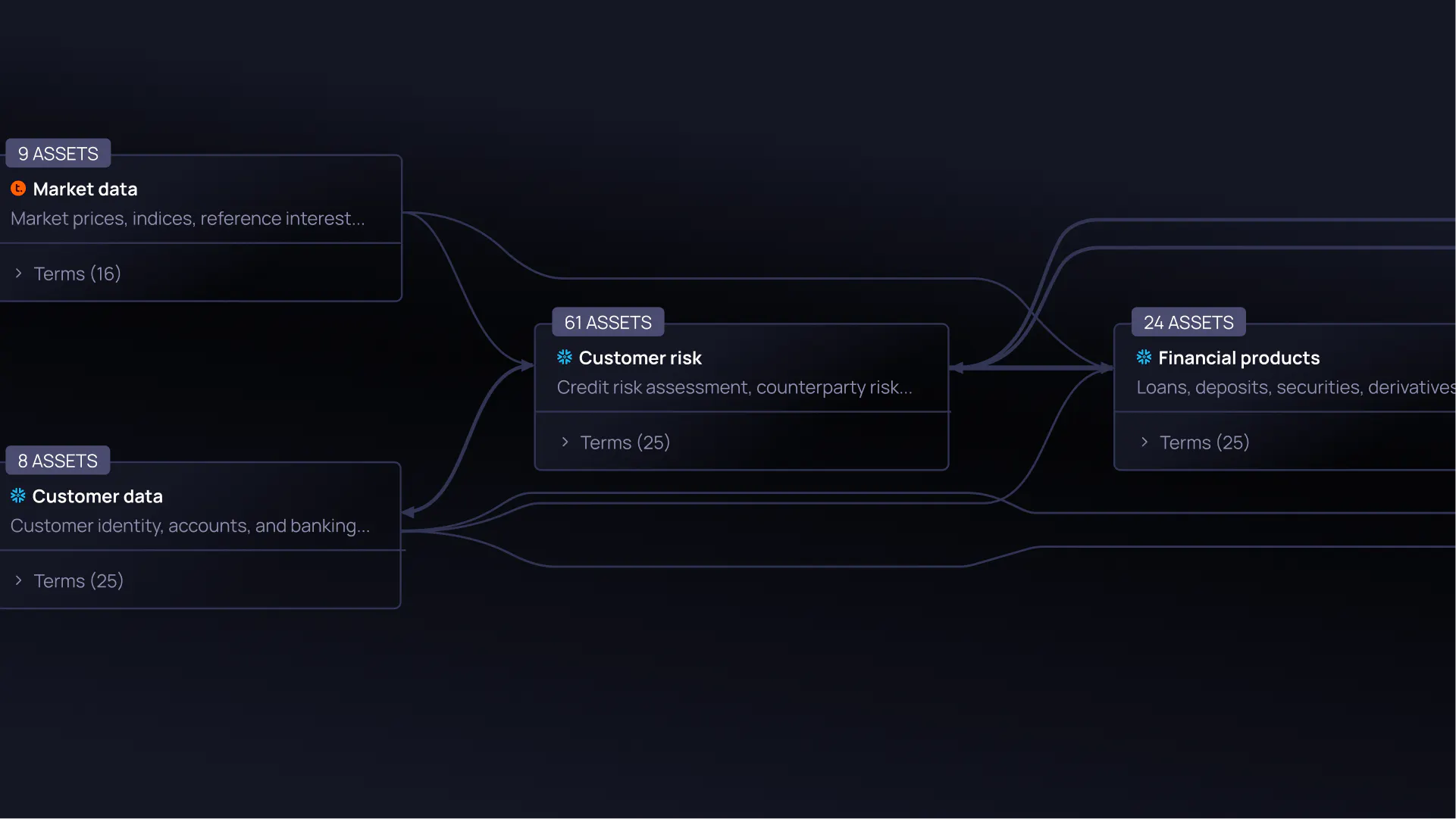
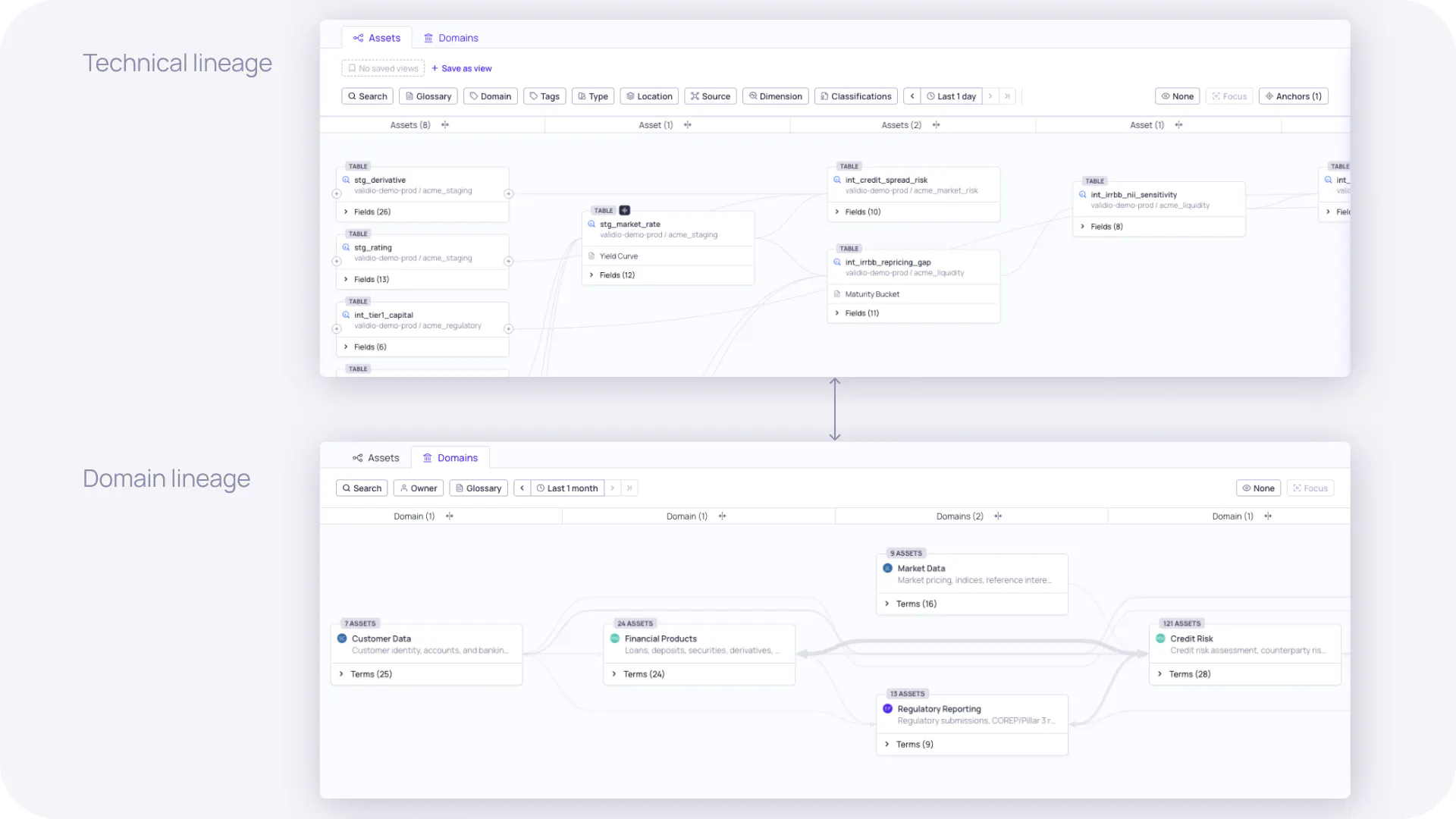
Domain Lineage is the business-level view of your lineage graph. Instead of tables, views, and fields, it shows domains as nodes, glossary terms as child items inside them, and term-to-term relationships as edges between domains. A risk manager sees Credit Risk flowing into Regulatory Compliance without ever seeing a schema. An auditor asks "which domains feed this report?" and gets an answer in the language the report uses.

The critical thing is that this graph is not a document you maintain. It's a view computed from metadata you were already producing. Two inputs:

  1. Technical lineage, which Validio auto-discovers from whatever sources your data estate actually uses: warehouse and catalog APIs, query logs, ETL tool integrations, DDL and view definitions, and OpenLineage events for external processes. The base layer is mostly hands-off.
  2. Glossary terms with domain assignments, applied to catalog assets and schema fields through standard governance work.

From those two inputs, the domain graph falls out:

  • Domain nodes come from the domains assigned to glossary terms.
  • Terms inside a domain come from term-to-asset assignments.
  • Edges between domains come from lineage edges connecting assets that carry terms from different domains.
  • Term-to-term links fall out of the glossary terms on those connected assets.

To make this concrete: tag the term risk-weighted assets (domain: Credit Risk) onto your counterparty exposures table. That one action produces a Credit Risk node, places risk-weighted assets inside it, and lights up every cross-domain edge involving that table. Technical lineage already knows what feeds and consumes it. If the table feeds a regulatory report carrying a term from Regulatory Compliance, an edge appears between Credit Risk and Regulatory Compliance. You did not draw that edge. You tagged one column.

No mapping exercise. No separate workstream. Coverage grows as your term assignments grow. The graph updates the moment either terms or lineage change. You are no longer producing a document about your data estate. You are reading a view from it.

Domain lineage combines the technical lineage with glossary to easily switch between data asset views and business area views.

The irreducible manual step: vocabulary, not maps

There is a catch. Sort of. Derivation requires inputs. Someone has to define what a glossary term means, attach a domain to it, and anchor it to at least some assets or fields. That's the residual manual work.

But this work is categorically different from drawing lineage.

Glossary curation is vocabulary work. It answers what do we call this, and what does it mean? Vocabulary holds up across schema changes. If the Credit Risk team decides "exposure at default" means gross exposure net of eligible credit risk mitigation, that definition stays valid when a new pipeline lands or a column gets renamed. The mapping work most tools ask for (this column connects to that column through this transformation) rots as soon as the pipeline changes. Vocabulary doesn't.

It's also work governance teams already do. Business glossaries exist because they're needed for search, compliance reporting, data product definitions, and executive communication. Domain Lineage doesn't add a workstream. It makes work you were already doing produce a second, live artifact for free.

And there's a producer/consumer split that matters. Stewards and governance teams curate the vocabulary. Business stakeholders (CDOs, risk managers, analysts, auditors) consume the derived graph. A business stakeholder never looks at a schema or a technical lineage view. They open the Domain Lineage tab and see the world in terms they already use.

Automation multiplies the residual manual work

Even vocabulary curation has a labor cost. The next question is how to shrink that cost over time rather than grow it with the data estate. This is where agentic automation does its most useful work.

Three amplifiers. Each takes one manual action and produces many graph outcomes.

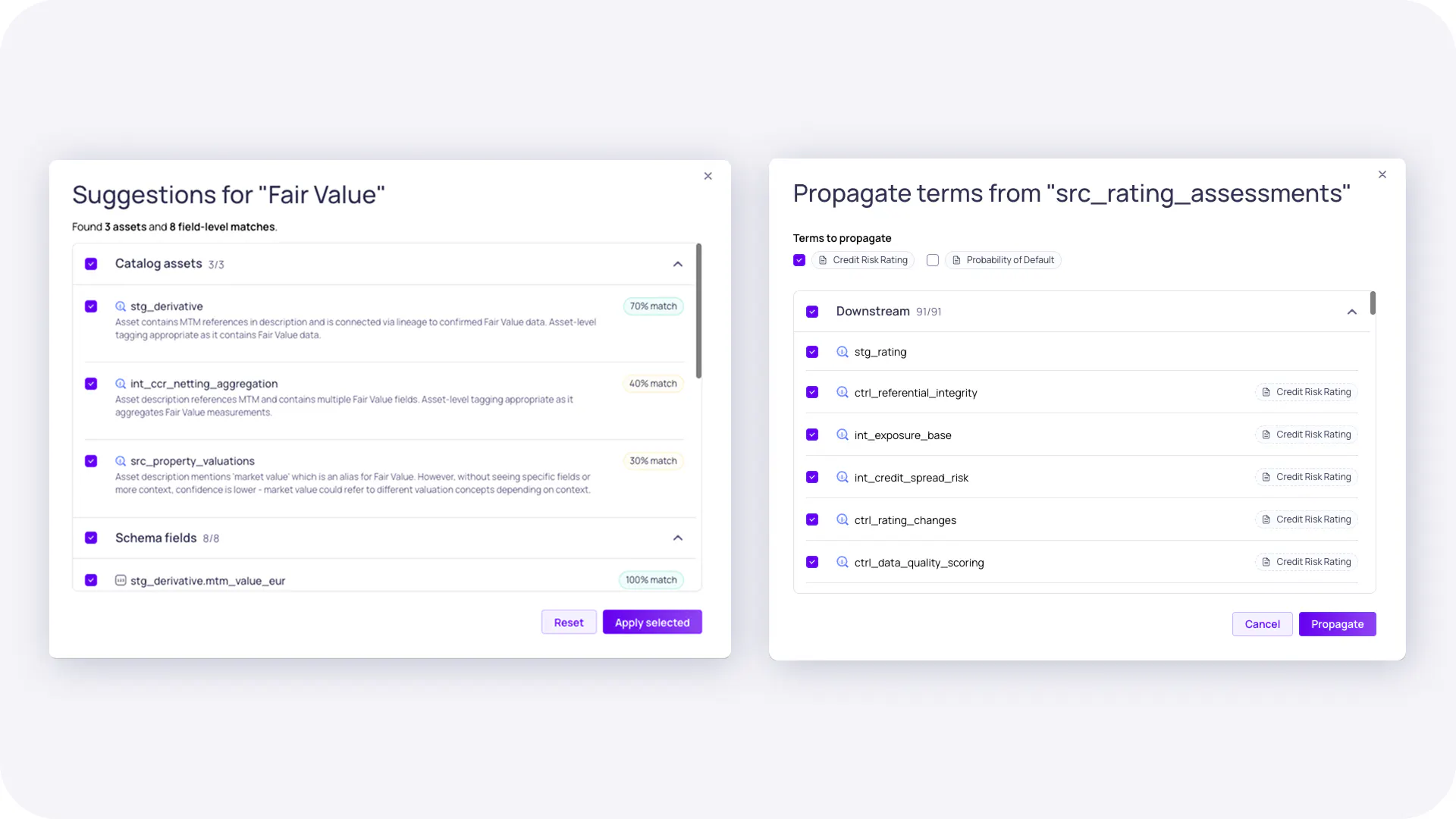
  1. Find the assets for me. Instead of hunting across the catalog for every place a term should live, Glossary Term Suggestions proposes the matches: a mix of text pattern matching, lineage analysis, and optional LLM refinement. The steward reviews and bulk-accepts. One workflow run, dozens of assignments.
  2. Spread the tag through the pipeline. Glossary Term Propagation spreads a manually assigned term along lineage edges to downstream (or upstream) fields. Propagated assignments carry origin metadata and are auto-removed when the source assignment is removed, so propagation unwinds itself as the estate changes. One manual tag, an entire lineage path covered.
  3. Bridge the systems auto-discovery can't see. Some parts of the data estate don't leave a trail that query logs or ETL tools can follow: legacy storage, files, APIs, partner data, anything that shows up as an OpenLineage event without the stitching to match. Suggest Lineage Edges fills those gaps. A two-tier matching algorithm (heuristic rules plus optional LLM refinement) proposes field-level connections across systems, scored with High, Medium, and Low confidence so you know what to review first. One run can stitch two warehouses together.

Automation multiplies the residual manual work. The graph is fully derived. The inputs are reviewed, not authored. This is majority automation with minor manual adjustments, and the adjustments are high-leverage judgment calls (does this term belong here? is this match correct?), not repetitive typing of the same tag onto the 47th downstream field.

Let the Validio agent find catalog assets and propagate the terms throughout the pipeline.

Why the graph stays alive

Here is the freshness payoff.

Because the domain graph is derived, it reflects the current state of terms and lineage the moment either changes. No rebuild step. No refresh. No reconciliation between the document and reality, because there is no document.

Because propagated assignments track their origin and auto-remove when their source goes away, the graph shrinks correctly when things retire. This is the hidden failure mode of every hand-maintained approach: old nodes linger forever because nobody remembers they exist. Derived lineage doesn't have that problem. A retired source drops its terms; the terms' downstream propagations unwind; the domain graph adjusts. Without a human standing over it.

Curation has governance controls. Approval workflows on glossary terms and data quality validations mean changes are reviewed, not ad-hoc: who proposed a term change, who reviewed it, when it took effect. That record is part of the audit trail.

The steward's role changes along with the artifact. From cartographer, drawing and maintaining the map, to curator, defining vocabulary and accepting suggestions. Human attention moves to where it adds real value.

That's what "alive" means: the artifact tracks reality without a human standing over it. That's the definition of a governance asset you can actually trust when a regulator, an auditor, or a CFO asks a question today.

Same data, different lens

Domain Lineage isn't a separate product surface. It's a presentation of the same graph, metadata, and data quality results that already power Validio's technical lineage and incident views.

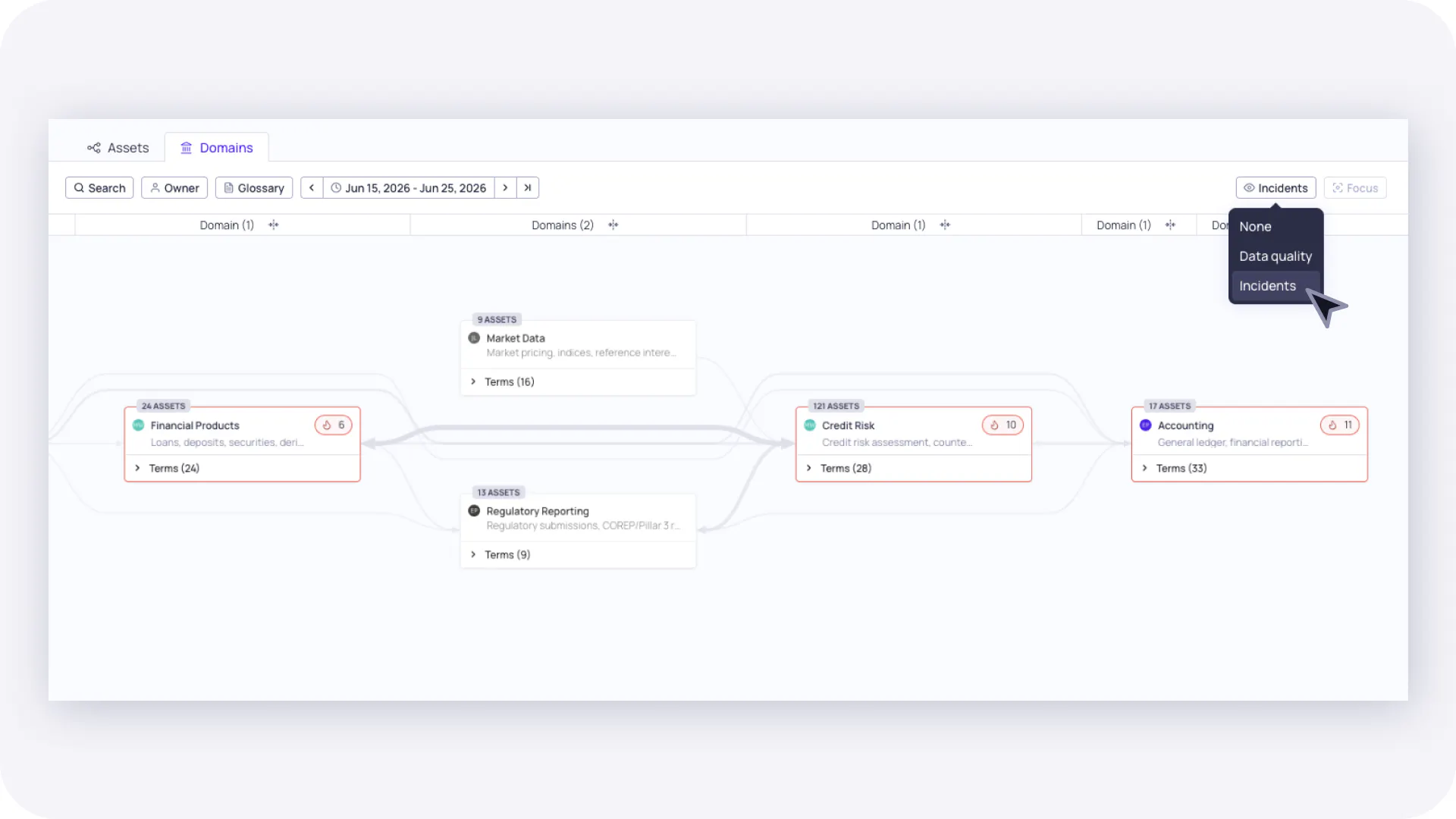
Incidents land on domain nodes. When a volume validator fails on a specific table, the Domain Lineage view shows the affected domain with an incident indicator. A business stakeholder sees "Credit Risk is affected" without needing to know the table name or which column fired.

Data quality health aggregates by domain. The Domain Lineage view can overlay DQ status per domain: which business areas are healthy, which have active incidents, where quality issues are concentrated. Useful for the question a CDO actually asks: which parts of the business are at risk right now?

Same data, different framing. A data engineer asks "which tables are affected by this incident?" A risk manager asks "which domains are affected by this incident?" Both answers come from the same substrate and stay consistent by construction. You never end up with two artifacts drifting apart, because there is only one artifact, presented two ways.

Just like in the technical lineage, you can toggle between showing incidents and data quality scores in the domain lineage.

The question to ask your tool

Back to the opening.

Next quarter, the CFO asks the question again. Three new pipelines have landed. Two schema changes rolled through. A reorg split a team. How long until the answer is ready? How confident will you be that the trace is still true?

If the answer involves someone opening a diagram drawn months ago, cross-checking it against the current state of the data estate, and manually confirming each hop, you are maintaining a document. Not deriving a graph. And next quarter's CFO question will take a week again.

The question to ask your lineage tool: when your data estate changes tomorrow, does your business lineage update itself, or does someone have to redraw it?

If the answer is "redraw," you're carrying the mapping tax. Every mid-sized data estate eventually bankrupts it.

Try domain lineage in Validio

Book a demo