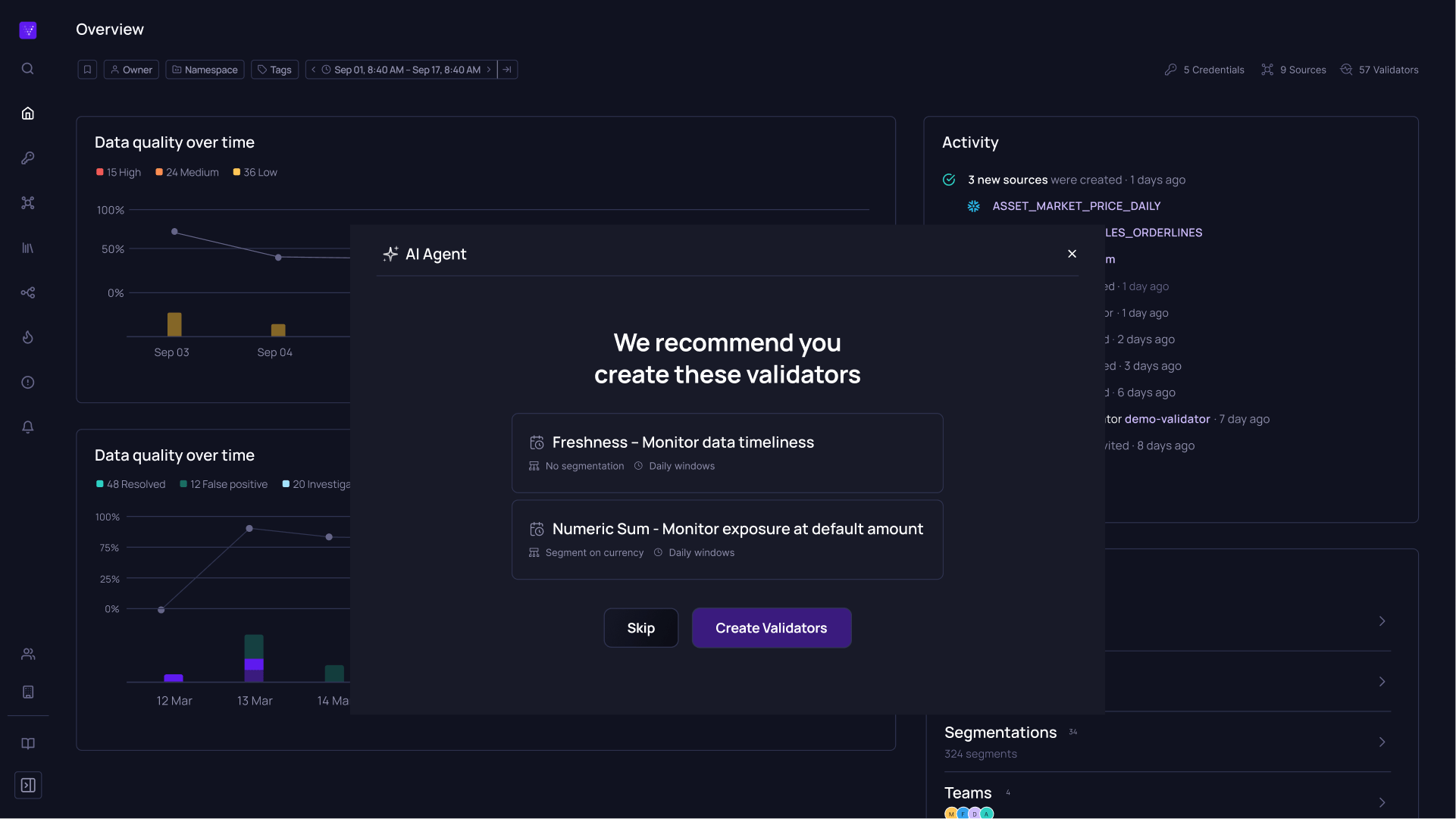


Gartner named agentic data management the leading trend in data and analytics for 2026. But buried inside that headline is a requirement most organizations are underestimating: you cannot build reliable agentic AI without trustworthy data at the foundation.
What is agentic data management?
Agentic data management refers to adaptive, self-learning systems that use AI-driven automation to optimize and streamline the entire data-to-impact life cycle. Rather than relying on human-triggered workflows, agentic systems use AI agents to autonomously monitor pipelines, detect and resolve issues, manage metadata, and prepare data for downstream AI consumption - continuously, and at machine speed.
Gartner's Top Trends in Data and Analytics for 2026 calls it the leading trend in data management today, predicting that by 2029, 20% of D&A leaders will have fully embraced it. The broader vision is clear: AI agents handling not just analytics, but the data operations that make analytics possible.
The goal is a data stack that runs itself. But that goal depends entirely on one thing the frameworks and orchestration layers can't provide on their own: data you can actually trust.
Why data quality is the prerequisite for agentic AI
When an AI agent makes a decision: flagging a fraudulent transaction, triggering a supply chain reorder, generating a risk report; it acts on whatever data it receives. There is no human in the loop reviewing inputs before the action fires. That's the point.
This is why data quality for AI agents is a fundamentally different problem than data quality for human analysts. Analysts notice when something looks wrong. Agents don't hesitate. A schema change upstream or a batch that arrived six hours late can corrupt an agent's inputs and produce confident, automated action on bad data.
The speed and autonomy that make agentic AI valuable are the same properties that make data quality failures dangerous. Bad data doesn't just produce a wrong answer. It produces a wrong action, often before anyone notices.
Gartner recognizes this directly. Their definition of agentic data management includes an explicit requirement for "safeguards, control, and trust." These aren't optional additions. They're the architectural prerequisite.
What "AI-ready data" actually requires
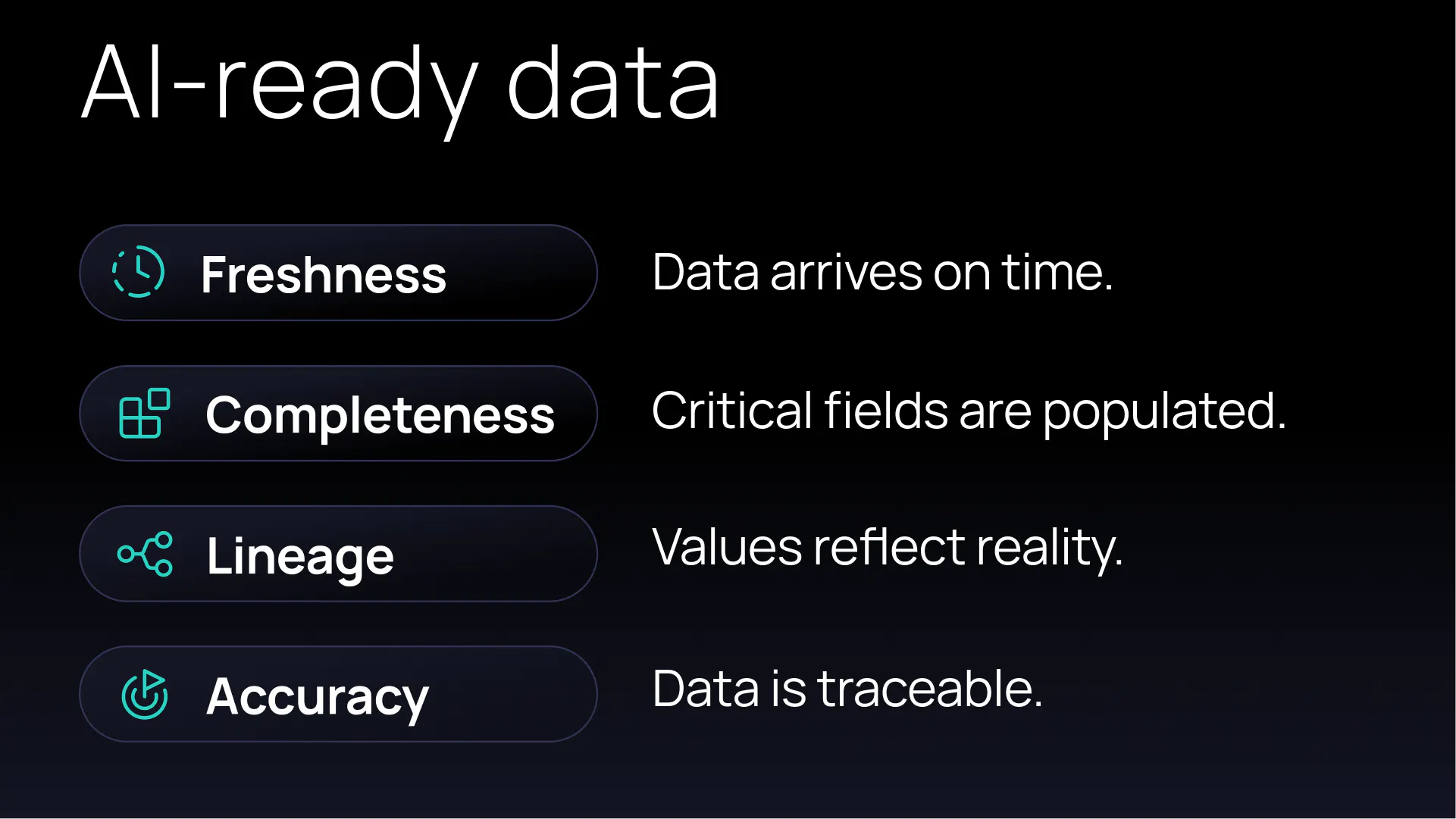
The term AI-ready data is increasingly common, but it means something precise in an agentic context. For AI agents to operate reliably, the data they consume must meet four conditions:
Accuracy: values reflect reality. Schema definitions are consistent. Referential integrity holds.
Freshness: data arrives on time. Late or missing data is detected and flagged before downstream agents act on stale inputs.
Completeness: critical fields are populated. Null rates are within expected bounds. Gaps are surfaced, not silently passed downstream.
Lineage: the origin and transformation history of every dataset is traceable. When an agent produces an unexpected output, you can answer: where did that data come from, and what happened to it?
None of these can be assumed. They have to be continuously monitored, which is precisely what platforms like Validio are built to do.
The role of data observability in agentic pipelines
Data observability is the ability to understand the health of your data across your pipelines in real time. In a traditional analytics context, it helps data teams catch issues before they reach dashboards or reports. In an agentic context, it becomes a non-negotiable operational requirement.
Agentic data pipelines move fast. Errors propagate faster. Without real-time monitoring, a data quality issue can travel through multiple agent steps, each compounding the problem, before a human ever sees a symptom.
Data quality and observability monitoring needs to happen continuously across your pipelines. This enables detection of anomalies automatically and surface them with root cause context, not just raw alerts. This means your data team knows what broke, where, and why, before it reaches the models and agents that depend on it.
This is what makes agentic data management trustworthy in practice: not the agents themselves, but the monitoring infrastructure that ensures the data they consume is clean, fresh, and correctly understood.
Data lineage: the governance layer agentic AI demands
Gartner's 2026 trends framework places decision governance at the center of responsible agentic D&A. The principle is straightforward: as AI agents take on greater decision automation, every automated choice must remain traceable, accountable, and auditable.
Data lineage is the foundation of that accountability. When an agent makes a bad call, or when a regulator asks how a model-driven decision was reached, lineage is how you answer. It shows which datasets were used, how they were transformed, and what version of the data the agent was working with at the time of the decision.
For organizations in financial services, healthcare, or any regulated industry, lineage isn't a compliance checkbox. It's the difference between being able to explain an automated decision and not being able to. Lineage capabilities needs to give data teams that visibility end-to-end, across complex pipeline environments.
Where Validio fits in the agentic data stack
Validio sits at the data layer: the layer that all agentic workflows depend on but that orchestration frameworks and AI platforms don't themselves address.
We are not an agent framework. We're the infrastructure that ensures the data your agents consume is data you can trust. Specifically:
- Real-time data quality monitoring across pipelines, detecting anomalies before they reach downstream agents or models
- Data observability with root cause analysis, so your team can act, not just be alerted
- End-to-end data lineage, tracing data from source to agent consumption, enabling audit trails and decision governance
- Automated anomaly detection, learning what "normal" looks like for your data and flagging deviations without manual rule-writing
Organizations moving toward agentic data management don't need to slow down. They need confidence that the data infrastructure underpinning their agents is solid. That's what Validio provides.
How to prepare your data foundation for agentic AI
If you're planning a move toward agentic use cases, here's where to start:
1. Audit your current data quality posture. Before you automate decisions, understand your baseline error rates, data freshness gaps, and unmonitored sources. Agents amplify whatever is already in your data, good or bad.
2. Implement data observability before deploying agents. Retroactively adding monitoring to agentic workflows is painful and risky. Build it in from the start. You need to know immediately when something changes in the data your agents depend on.
3. Establish data lineage as a governance requirement. Lineage should be designed into your data architecture, not bolted on after the fact. It's the audit trail that makes automated decisions defensible, and the diagnostic tool that makes failures debuggable.
4. Treat data quality as a continuous process, not a one-time fix. Data drifts. Schemas evolve. New sources are added. AI-ready data is a state you maintain, not a condition you achieve once.
The bottom line
Gartner's identification of agentic data management as the #1 D&A trend for 2026 reflects a real shift in how enterprises think about data operations. The direction is clear: more automation, more autonomy, faster data-to-impact cycles.
But the organizations that will actually succeed with agentic AI are the ones that solve the data foundation problem first. You cannot build trustworthy autonomous systems on unmonitored, unobserved data pipelines.
Data quality, observability, and lineage aren't the boring prerequisites you clear before the interesting work begins. They are the interesting work. And in 2026, they're what separates agentic AI that delivers value from agentic AI that fails in production.
Validio was built for exactly this moment.
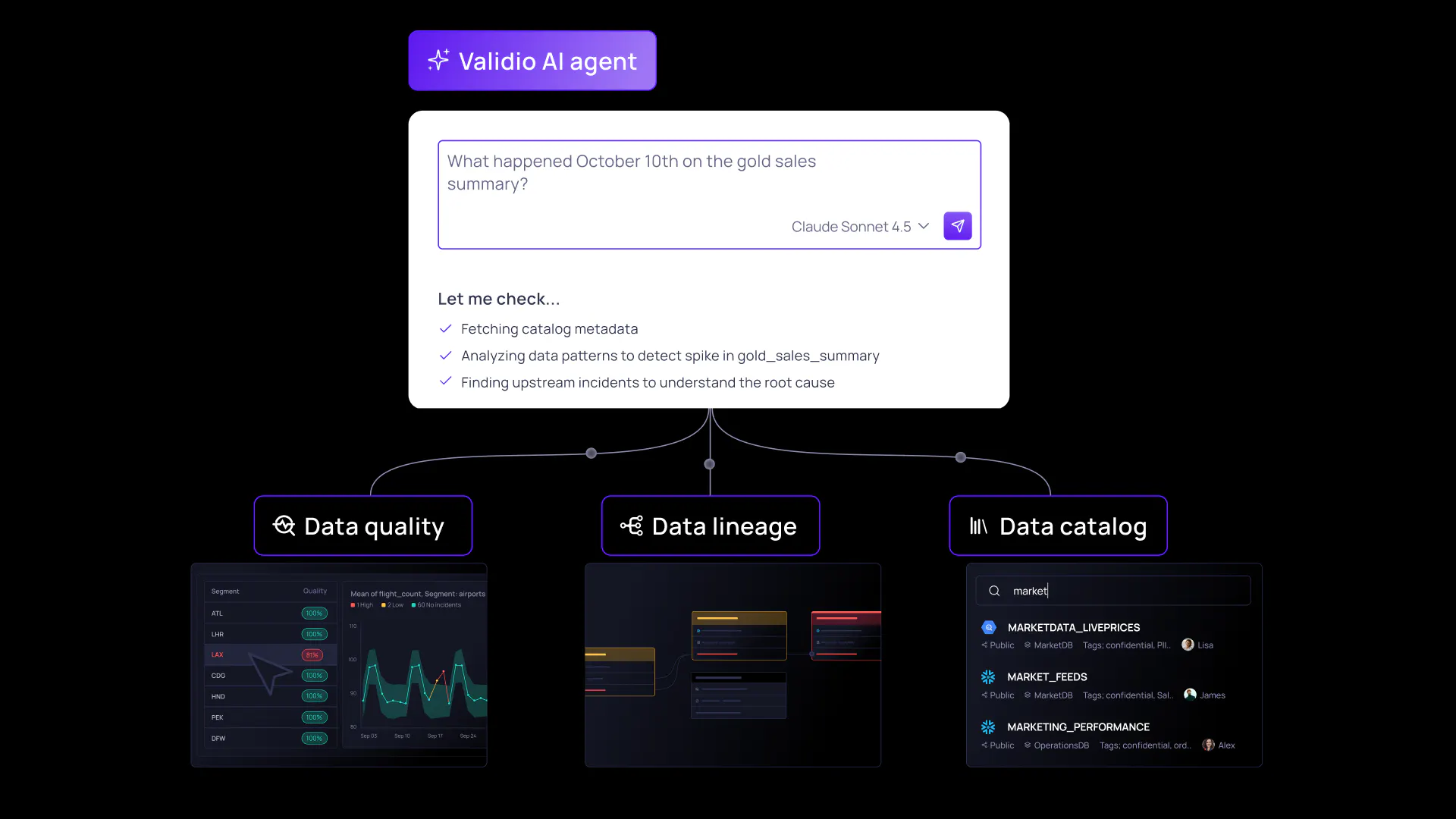
Validio's purpose-built AI agents automate data quality workflows
Frequently asked questions
What is agentic data management? Agentic data management is the use of AI agents to autonomously monitor, manage, and optimize enterprise data pipelines, including data quality validation, metadata management, anomaly detection, and pipeline orchestration, with a human in the lead or in the loop.
Why does data quality matter for AI agents? AI agents act autonomously on the data they receive. Unlike human analysts, they don't pause to question suspicious inputs. Poor data quality, like inaccurate values, stale data, schema drift, leads directly to incorrect automated decisions, often before anyone detects the problem.
What is data observability? Data observability is the ability to continuously monitor the health, accuracy, freshness, and completeness of data across pipelines in real time. It provides the visibility teams need to detect and resolve data quality issues before they affect downstream analytics or AI systems.
What is AI-ready data? AI-ready data is data that is accurate, fresh, complete, and traceable - structured and governed in a way that AI models and agents can consume reliably. It requires continuous data quality monitoring, observability, and lineage tracking to maintain.
How does Validio provide agentic data management? Validio automates data quality monitoring, anomaly detection, cataloging, and end-to-end lineage, with purpose-built agents driving complete data quality workflows. This gives teams the visibility and control they need to ensure the data feeding their AI agents is trustworthy and audit-ready.